Bookkeeping for Austin, Tx Boutique Fitness Studio Owners
Fitness Studio Bookkeeping Tips and Tricks:
Running a successful boutique fitness studio requires more than great instructors and a motivated client base. A well‑designed chart of accounts with a numbering system tailored to studios provides the financial clarity you need to track revenue, manage costs, and make confident business decisions.
Fitness studios juggle multiple revenue streams - memberships, class packages, personal training, retail merchandise and variable expenses like instructor pay, rent, equipment depreciation, and software subscriptions. Without a customized system, it’s hard to see which revenue streams are truly profitable, manage cash flow wisely, or plan for slow seasons.
As specialists in fitness industry bookkeeping, we’ve helped studio owners implement numbering systems that provide consistent, actionable financial insights. This guide shows you how to organize your chart of accounts so you can manage growth with ease.
Why Boutique Fitness Studios Need a Specialized Chart of Accounts
General bookkeeping templates fail to capture industry-specific financial nuances. Fitness studios need to categorize:
Membership income separately from classes, group trainings, retail
Payroll by role - instructors vs. front desk vs. trainers
Equipment depreciation and maintenance
Software subscriptions (Mindbody, ClubReady, etc.)
Deferred revenue from prepaid packages
These distinctions affect pricing strategies, staffing decisions, and tax planning. A structured system allows you to answer questions like: Are personal training packages more profitable than single classes? Is rent eating into class margins? When should I plan for equipment upgrades?
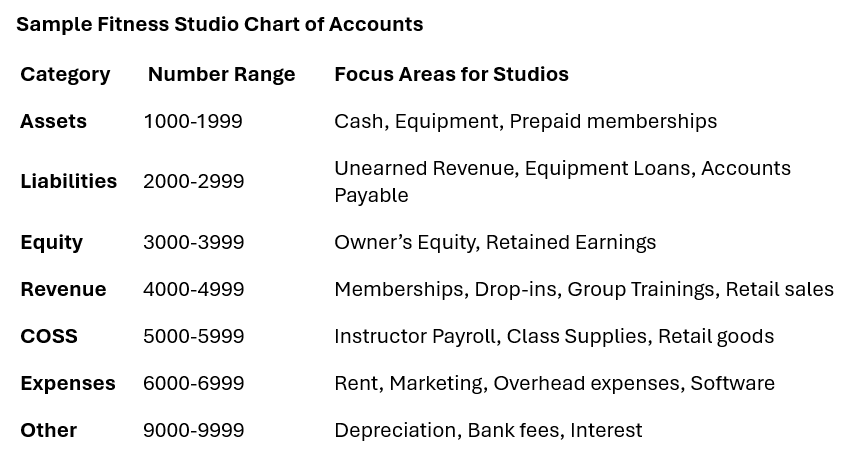
Standard Account Numbering Structure for Fitness Studios
A 5‑category chart of accounts structure, with tailored ranges, works well.
Leaving gaps between numbers (e.g. 4100, 4110, 4120) makes future additions easy and orderly.
Revenue segmentation: Know What’s Really Driving Your Business
One of the most powerful benefits of a well-structured chart of accounts is the ability to separate and track different revenue streams. For boutique fitness studios, this goes beyond simply “class revenue” or “membership income.” You’ll want to distinguish between:
Monthly membership fees (recurring revenue)
Drop-ins (one-time transactions)
Class packs or bundles (e.g., 10-class pack)
Promotional or intro offer
Class pass bookings
Private training sessions or semi-private group training
Retail and merchandise sales (apparel, supplements, grippy socks)
Tracking these revenue categories separately gives you visibility into what’s most profitable and consistent. For example, class packs may generate more revenue upfront, but memberships offer steadier cash flow. Similarly, drop-ins may be priced higher per class but have more sporadic usage.
It’s also valuable to analyze revenue by class type (yoga, HIIT, barre, cycling) or time of day. Some studios find that early morning classes consistently outperform midday offerings, or that certain instructors draw higher attendance and revenue. Creating revenue sub-accounts by class format or time block allows you to:
Adjust class schedules to match demand
Price premium classes accordingly
Allocate marketing budget to underperforming time slots
Identify which offerings to expand or cut
Studio management platforms like Mindbody, Glofox, or Acuity often allow you to tag or label each revenue source and even assign it to a corresponding category in your bookkeeping system. When set up correctly, these systems make it easy to export reports that align with your chart of accounts, saving hours of manual sorting and reducing errors.
Ultimately, when you have visibility into what type of revenue is coming in, from where, and when, you’re able to make more strategic decisions about pricing, staffing, scheduling, and marketing. That’s the power of smart bookkeeping tailored to the boutique fitness world.
Expense Segmentation: Track Spending with More Clarity
Just like revenue, your studio’s expenses should be broken down into categories that reflect how your business actually operates. This helps you control costs, spot patterns, and make more strategic decisions. Especially as you grow or start planning for big investments.
Separating your expenses into two major categories - Cost of Services Sold (COSS) and General & Administrative (G&A) gives you a more accurate view of profitability, especially when analyzing profit margins per service.
Cost of Services Sold (COSS)
These are the direct costs of delivering your classes, private training, and fitness services, the expenses that scale with how busy you are.
Instructor payroll (class-based or hourly instructor wages)
Class supplies & equipment (weights, resistance bands, yoga mats)
Class software fees (Proportional fee of booking platform)
Retail product costs (Wholesale cost of merchandise or supplements sold)
General & Administrative (G&A) Expenses
These are the operational costs of running your business - they don’t change much based on how many classes you offer.
Studio rent & utilities (Rent or lease payments and utility bills)
Admin and contractor wages
Software & subscriptions (Studio management tools)
Marketing & Advertising (SEO, Google Ads)
Professional Services (Accounting/bookkeeping, consultant)
Liability and business insurance
Education & Training (instructor certifications, workshops)
Other Expenses (interest, bank fees, small repairs)
By categorizing your expenses this way, you can better analyze profitability, control overhead, and plan ahead. Whether that means launching a new class format, opening a second location, or just taking a well-earned break.
Equipment & Class Tracking
Fitness equipment is a capital-intensive investment. To manage it effectively, use distinct account numbers in your chart of accounts, for example:
1400s Equipment for large purchases like reformers, spin bikes, or treadmills
1500s Accumulated depreciation to track the declining value of that equipment over time
Recording these as fixed assets instead of regular expenses not only aligns your books with proper accounting practices but also gives you visibility into the long-term value of your studio’s physical resources.
Maintenance and minor repairs (e.g., tightening pedals, replacing yoga mat straps) should be tracked separately as regular expenses, ideally under something like 6040 Equipment Maintenance, so you can monitor upkeep costs and evaluate whether it’s more cost-effective to repair or replace.
Similarly, categorizing revenue by class type adds another layer of insight. You can add a “class type” tag to revenue and expense transactions, for example:
HIIT
Cycling
Yoga
Pilates
This structure allows you to assess profitability and popularity by class format. Over time, you may notice seasonal patterns (e.g., yoga attendance spikes in January, cycle slows in summer), which can help you optimize your schedule, staffing, and promotional efforts accordingly.
If your studio hosts pop-up events, guest instructors, or themed classes, those can also be broken out under a unique code (e.g., 4150 Events & Collaborations) to evaluate their standalone performance.
Organizing your financial data this way empowers you to make better decisions around programming, equipment investment, and long-term planning, all without guesswork.
Best Practices for Implementation
Leave room to grow: use intervals (e.g., 4100, 4200…) to leave space for new revenue streams.
Train your team: staff must know how to record revenue and expenses correctly, especially with prepaid packages or class pack bundles.
Software integration: map studio management software (Mindbody, etc.) to your accounting categories for seamless automation
Monthly reconciliation: reconcile bank statements, credit cards, and deferred revenue each month to stay accurate.
Common Mistakes to Avoid
Using a generic chart of accounts without customization
Not separating deferred membership revenue from current income
Bundling payroll into a single labor account instead of breaking it out by role
Forgetting to record depreciation on equipment
Not reviewing or updating the chart of accounts as your studio evolves
Conclusion
A well-structured chart of accounts with a tailored numbering system is the backbone of financially healthy, growing boutique fitness studios. It provides the visibility needed to:
Identify your most profitable revenue sources
Manage costs and staff efficiently
Make data-driven investment and equipment decisions
Smooth tax reporting and financial planning
If you’d like a ready‑to‑use template or help customizing one for your studio’s unique operations, feel free to reach out. At For the Books, we specialize in boutique fitness bookkeeping that simplifies finances - and gives you back time to focus on what you love.
Disclaimer:
The information provided on this blog by For the Books is intended solely for general informational purposes and should not be construed as accounting, tax, legal, or professional advice. While we strive to provide accurate and timely content, every individual’s circumstances are unique. Therefore, you should consult with a qualified accountant, tax advisor, or other professional before taking any action based on the information presented here. For the Books expressly disclaims any liability for decisions made or actions taken based on this blog’s content.