Bookkeeping Tips for Austin, TX Event Planners
Event Planning Business Bookkeeping Tips and Tricks:
Running a successful event planning business takes more than creative event concepts and satisfied clients. A well-designed chart of accounts with a numbering system tailored to event planners provides the financial clarity you need to track revenue, manage costs, and make confident business decisions.
Event planners juggle multiple revenue streams, including weddings, corporate events, social gatherings, consulting, and outsourced services. They also manage variable expenses like vendor payments, venue rentals, décor and supplies, software subscriptions, and staff overhead. Without a customized system, it’s hard to see which event types are truly profitable, manage cash flow wisely, or plan for seasonal demand.
As specialists in small business bookkeeping, we’ve helped event planning businesses implement numbering systems that deliver consistent, actionable financial insights. This guide shows you how to organize your chart of accounts so you can scale with ease.
Why Event Planning Businesses Need a Specialized Chart of Accounts
Generic bookkeeping templates fail to capture the financial nuances of event planning. Event planners benefit from categorizing:
Revenue from weddings, corporate events, and social gatherings separately
Vendor reimbursements vs. event planning service revenue
Payroll by role: event coordinators, assistants, designers
Software subscriptions (event management tools, scheduling apps, design software)
Deferred revenue from pre-paid bookings or deposits
These distinctions impact pricing, staffing, and tax planning. A structured system helps you answer questions like:
Are corporate events more profitable than social events?
Are vendor reimbursements skewing revenue reports?
Which service lines deserve more investment or marketing focus?
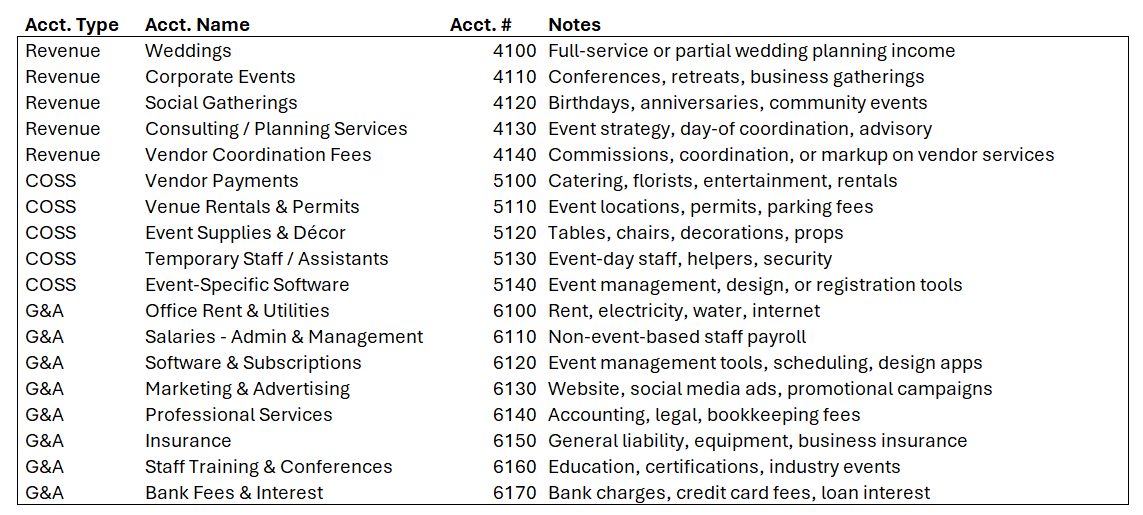
Standard Account Numbering Structure for Event Planning Businesses
A 5-category chart of accounts with tailored number ranges works well.
Leaving gaps between numbers (e.g. 4100, 4110, 4120) makes future additions easy and orderly.
Make it stand out
Whatever it is, the way you tell your story online can make all the difference.
Revenue Segmentation: Know What’s Really Driving Your Event Planning Business
One of the most powerful benefits of a tailored chart of accounts is separating and tracking different revenue streams. For event planners, this means going beyond a single “service revenue” account. You’ll want to distinguish between:
Weddings
Corporate events
Social gatherings (birthdays, anniversaries, community events)
Consulting or planning services
Vendor commissions or coordination fees
Tracking these separately gives you insight into what’s most profitable and consistent. For example, weddings may offer predictable high-value revenue, while corporate events create spikes that require higher upfront costs. Some planners also segment by service type - full-service planning, day-of coordination, décor, or entertainment coordination - to see which lines are performing best.
This lets you:
Adjust marketing focus based on profitability
Price premium services accordingly
Allocate team resources efficiently
Decide which offerings to scale or phase out
Expense Segmentation: Track Spending with More Clarity
Just like revenue, your event planning business’s expenses should reflect how your business actually operates. Break them into two main categories, Cost of Services Sold (COSS) and General & Administrative (G&A), for a clearer picture of profitability.
Cost of Services Sold (COSS)
Direct costs tied to client deliverables:
Vendor payments (catering, florists, entertainment)
Venue rentals or permits
Event-specific décor and supplies
Temporary staff or assistants
Event-specific software or design tools
General & Administrative (G&A) Expenses
Ongoing business costs that don’t vary much with project volume:
Office rent & utilities
Salaries for admin and management staff
Software & subscriptions (event management tools, scheduling apps, design software)
Marketing & business development
Professional services (accounting, legal)
Insurance
Staff training & conferences
Bank fees & interest
Categorizing this way allows you to measure profit margins per event type and control overhead more effectively.
Best Practices for Implementation
Leave room to grow: Use number intervals (e.g., 4100, 4200) so you can add new event types later without reorganizing your chart.
Train your team: Make sure anyone handling bookkeeping or invoicing knows how to code revenue and expenses correctly, especially for pre-paid events or deposits.
Software integration: Connect your invoicing or project management platforms (like QuickBooks, Dubsado, or HoneyBook) to your chart of accounts for smoother tracking.
Monthly reconciliation: reconcile bank statements, credit cards, and deferred revenue each month to stay accurate.
Common Mistakes to Avoid
Using a generic chart of accounts without industry customization
Mixing vendor reimbursements with service revenue
Combining all labor costs into one account instead of breaking out by role or event type
Not tracking profitability per service line
Letting your chart of accounts go stale as your offerings evolve
Conclusion
A well-structured chart of accounts with a numbering system built for event planning businesses gives you the visibility to:
Identify your most profitable services
Manage costs and vendors efficiently
Make informed hiring and investment decisions
Streamline tax reporting and forecasting
If you’d like a ready-to-use template or help customizing one for your event planning business, reach out. At For the Books, PLLC, we help small event planners simplify their finances so they can focus on creating unforgettable events - and growing their bottom line.
Disclaimer:
The information provided on this blog by For the Books is intended solely for general informational purposes and should not be construed as accounting, tax, legal, or professional advice. While we strive to provide accurate and timely content, every individual’s circumstances are unique. Therefore, you should consult with a qualified accountant, tax advisor, or other professional before taking any action based on the information presented here. For the Books expressly disclaims any liability for decisions made or actions taken based on this blog’s content.